
Gold and silver prices experienced a significant drop in the national capital due to a global selloff driven by inflation concerns, central bank policies, and geopolitical tensions.

Among the Sensex constituents, Asian Paints, Tech Mahindra, HCL Technologies, Tata Steel, Maruti Suzuki India, Sun Pharmaceuticals, Tata Consultancy Services, ICICI Bank, Bajaj Finance, UltraTech Cement, Mahindra & Mahindra and Tata Motors Passenger Vehicles were the laggards. However, Eternal, Titan, Adani Ports, Bharat Electronics Ltd, State Bank of India, Bajaj Finserv, NTPC and Bharti Airtel were among the gainers.

By piling more pressure on governments, central banks risk not accomplishing much and yet provoking a political backlash that could threaten their independence.

Indian stock markets experienced a significant rally following the announcement of a US-Iran ceasefire, coupled with a drop in crude oil prices. The Sensex and Nifty both closed nearly 4 per cent higher, mirroring gains in global markets.

'It was diminishing even before Trump came to power.' 'The US was at the centre of the global economy. That position is going to become less and less important and less central.'

In an event-heavy week, stock investors will track ongoing quarterly earnings, the US Federal Reserve's interest rate decision, and macroeconomic data for market direction, analysts said. Moreover, progress in India-US trade negotiations will remain a key focus for investors, an expert said.

Among Sensex firms, Sun Pharma, Tata Steel, Power Grid, Asian Paints, NTPC and Bharti Airtel were the biggest laggards. Tata Consultancy Services, Tech Mahindra, Infosys, Adani Ports, Axis Bank and HCL Tech were among the gainers.

The 30-share Sensex is up 253 points at 29,263 and the 50-share Nifty has gained 68 points at 8,829.

Announcement of macroeconmic data such as industrial production and inflation, the US Federal Reserve's interest rate decision along with trends in global equities would dictate movement in the stock market this week, analysts said. Besides, foreign fund trading activity would also guide the trends in equities. "All eyes are now on the US Fed policy outcome for cues, which is scheduled on June 14. In the following sessions, the European Central Bank (ECB) and Bank of Japan (BoJ) will also announce their policy decisions.

Amid US-China trade tensions and economic vulnerabilities, India must seize the 'China +1' opportunity, deepen reforms, secure FTAs, and globalise its firms for long-term growth, suggests Ajay Shah.

Of the eight RBI governors who have held office since the 1991 economic liberalisation, Bimal Jalan had the longest stint and S Venkitaramanan, the shortest. Current Governor Shaktikanta Das will overtake Bimal Jalan before completing his second term in December, points out Tamal Bandyopadhyay.

Bharti Airtel was the biggest gainer in the Sensex pack, rising 2.37 per cent, followed by Mahindra & Mahindra, HCL Tech, Tata Motors, Tech Mahindra, HDFC Bank, Wipro, Tata Consultancy Services, Axis Bank and Nestle. Asian Paints, Hindustan Unilever, Bajaj Finserv and NTPC were among the laggards.

Quarterly earnings, global trends and trading activity of foreign investors will drive stock markets in this holiday-shortened week, analysts said. It will be a trading holiday on January 22, with the Maharashtra government announcing a holiday in connection with the consecration of the Ram Temple in Ayodhya. Equity markets would also remain closed on Friday for Republic Day.

As the results season kicks in, the quarterly earnings numbers of several blue-chip firms -- such as Infosys and Reliance Industries -- along with global trends and trading activity of foreign investors, will determine equity market movement in the holiday-shortened week ahead, according to analysts. The domestic WPI inflation data for June -- scheduled to be announced on Monday -- will also influence trading sentiments, traders said. Markets will remain closed on Wednesday for Muharram.

While the RBI can nudge things along, ultimately bank owners must recapitalise and review internal processes to ensure that a culture of irresponsible lending doesn't continue, says Devangshu Datta.

On February 22, 2013, the Reserve Bank of India issued guidelines on 'Licensing of New Banks in the Private Sector'.
Equity indices overcame a wobbly start to clock gains for the third session on the trot on Tuesday, propped up by banking, metal and energy stocks amid a mixed trend in global markets. A recovery in the rupee also bolstered sentiment, traders said. The 30-share BSE Sensex advanced 246.47 points or 0.45 per cent to settle at 54,767.62 after starting the trade on a weak note. In a volatile session, the benchmark hit a high of 54,817.52 and a low of 54,232.82 during the day.
BSE IT index was the biggest sectoral loser, down 1.5% dragged by TCS

Top gainers in the Sensex pack included Vedanta, ICICI Bank, ONGC, Kotak Bank, Axis Bank, SBI, M&M, Infosys, PowerGrid, HCL Tech, NTPC, Bajaj Finance and Reliance Industries, rising up to 2.72 per cent.
Markets ended lower for the third straight day on Tuesday weighed down by profit taking in rate sensitives with bank shares leading the decline after hopes of rate cut by the central bank faded.

Out of 30 Sensex shares, 19 ended lower while 11 gained

'When I came here in 2002, I said you can grow at 8%.' 'And I was told that was crazy, and (now) here we are.'

Among other stocks, IT firm Mphasis today reported a 15.30% increase in consolidated net profit at Rs 184.72 crore for the quarter ended September 30, 2015.
From the Sensex pack, Infosys, HCL Technologies, Infosys, NTPC, Mahindra & Mahindra, Tata Consultancy Services, Nestle, Tech Mahindra and Bajaj Finance were the major gainers. Power Grid, Larsen & Toubro, Maruti, Titan, HDFC Bank, Wipro, HDFC and ITC were among the laggards.
'India's fundamentals are a lot better (than those of other emerging market economies).' 'India will suffer (witness a fall in its stock market) what I call the second order effect.' 'And the second order will happen when these funds (belonging to macro and hedge fund investors and which have leveraged Japanese yen-carry trades), because they lose money elsewhere as lot of their positions were financed by borrowing Japanese yen, will have to book profits in investment destinations where they are making money, including in markets like India.' 'They (these investors) will have to effectively sell in countries like India and which is the consequence (the crash in equity markets) that Indian markets might see.'

The US Trade Representative noted that India's average applied tariff rate stood at 17% per cent, the highest of any major world economy.
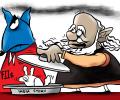
Foreign portfolio investors (FPIs) turned net buyers in October after being net sellers in the previous month. In October, FPIs bought shares worth nearly Rs 8,430 crore ($1 billion) against net selling of Rs 13,405 crore ($1.6 billion) in September. Positive flows during three of the previous four months have pushed the domestic markets towards fresh all-time highs. At present, the Sensex and Nifty are less than 2 per cent shy of breaching record highs logged in October 2021. A rally in equity markets in the US and Europe is in hopes that the Federal Reserve may go soft on rate hikes after its November meeting.

India should not be left behind. It should join the seven central banks which are studying feasibility and safeguards necessary to eliminate risks, particularly from hacking, advises former foreign secretary Shyam Saran.

Three major central banks have hit the zero limit, the Fed, the European Central Bank and the Bank of Japan.

The rupee has lost ground since pre-Budget, against three major hard currencies (yen, dollar and euro). The European Central Bank and the Bank of Japan maintained status quo in recent policy meetings

Maruti Suzuki fell 0.7% even after its March quarter profit grew by 15.8% to Rs 1,709 crore in Q4

The Reserve Bank on Wednesday allowed inbound travellers from G20 nations arriving at select airports to use the popular UPI for making payments in the country. Later, the RBI also proposes to extend the Unified Payments Interface (UPI) facility to travellers from all countries. UPI is a system that powers multiple bank accounts into a single mobile application, merging several banking features, seamless fund routing & merchant payments into one hood.

Many fear that in practice if banks make their customers pay to hold their money, it might lead to a situation where consumers hold on to cash.

What is killing the risk appetite of the bond buyers is the inconsistency in the central bank's approach. It needs to allow the yield to find its own level, gradually. To ensure that, the RBI may adopt a similar approach with which it handles a slipping rupee, asserts Tamal Bandyopadhyay.

The IMF has encouraged both the UK and the EU to work collaboratively towards a smooth transition.

Among the Sensex firms, Bajaj Finance emerged as the biggest gainer by climbing 2.95 per cent. Tata Motors, Bajaj Finserv, IndusInd Bank, Sun Pharma, Mahindra & Mahindra, State Bank of India, Larsen & Toubro, HDFC, HDFC Bank, Maruti, Reliance Industries and Bharti Airtel were the other major winners. HCL Technologies, Axis Bank, ICICI Bank, Tech Mahindra and Titan were among the laggards.

'Additionally, the significant employment multiplier will boost direct and indirect jobs of up to 1.1 million.'

Reserve Bank of India Governor Raghuram Rajan took charge of India's central bank when the rupee seemed to be in a tailspin while the country was facing runaway inflation.

'India is not so distant from years of high and entrenched inflationary expectations that it should start trying to play games with the economy the way the West's central bankers think they are entitled to,' argues Mihir S Sharma.
The 30-share Sensex ended higher by 177.46 points at 28,885.21 and the Nifty gained 63.90 points at 8,778.30.
 © 2026 Rediff.com - Advertise with us - Disclaimer - Privacy Policy - Sitemap - Feedback - About us - Terms of use - Grievances